
A practical guide to the project types, tools, and real-world applications you can build with Bitcoin – the world’s most open financial network.
Who this guide is for
This guide is written for project leaders: people who turn ideas into real products. That includes:
- Solo entrepreneurs with a budget and a Bitcoin idea
- Business leaders with a love for Bitcoin
- Fintech founders and operators who think of Bitcoin beyond an investment
You do not need to be a protocol expert to benefit from this guide. What you need is a business problem, an idea you want to test, and a mandate to turn it into something real.
Background
Velas Commerce has been building Bitcoin projects for over ten years. We started by specializing in Bitcoin payment integrations for e-commerce during the BitPay era, and have continued to expand into new project types as the market and tooling have matured. The project types in this guide reflect real development experience across all of them.
Introduction
Bitcoin is a tool unlike anything else. It is a permissionless global money system with tooling and infrastructure unrivalled by any other financial technology. For builders, this means access to a worldwide payment rail, a growing developer ecosystem, and a die-hard user community hungry for new products.
This guide breaks down the major project types, the tools that power them, and real-world examples, so you can move from idea to prototype with confidence.
The project type map
There are three strategic buckets, each containing related project types.
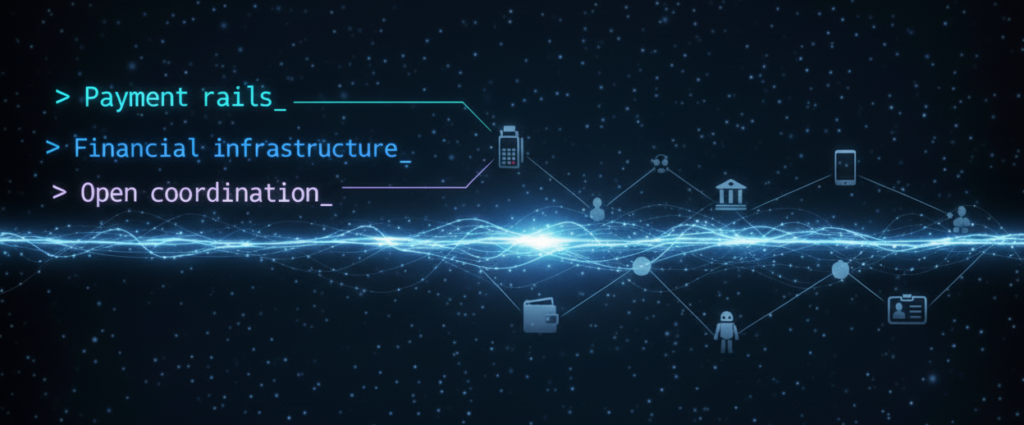
Block 1 – Bitcoin as a payment rail
Global, programmable payments for humans and machines.
The original Bitcoin use case – this is the most accessible entry point for most businesses and often the highest-ROI one. If adding Bitcoin to your balance sheet is on your roadmap, the best way to get bitcoin is to earn it by accepting Bitcoin payments.
Accept Bitcoin payments
Add Bitcoin to your website, app, or brick-and-mortar checkout. This opens your business to international payments without the friction of traditional finance. Getting paid in Bitcoin is also among the most direct ways to accumulate it on a balance sheet.
With Apple now required to allow third-party payments on iOS, Bitcoin payments are newly viable for mobile apps as well.
BTCPay Server Square OpenNodeExamples: E-commerce checkout, B2B invoice settlement, in-store POS terminals, mobile app purchases
Bitcoin rewards platforms
Lightning Network payments make it possible to send tiny fractions of a bitcoin instantly and at near-zero cost. This unlocks rewards, incentive loops, and engagement mechanics that simply are not viable with traditional payments infrastructure.
Bitcoin rewards systems are already powering engagement on platforms that might not immediately come to mind: video gaming, fitness apps, and debit and credit card rewards programs among them.
LDK LND LNBits Breez SDKExamples: Gaming reward payouts, fitness app incentives, debit/credit card cashback, loyalty programs
AI agent payments
AI agents exist without borders and without traditional identity. They need a way to pay for data, APIs, and services as they operate autonomously. Bitcoin – and Lightning in particular – is uniquely suited for this.
It also answers a pressing question for content publishers: how do you get paid when AI agents outnumber human visitors?
Stack Overflow’s traffic data tells the story clearly. Programming language search traffic dropped sharply in 2022 – not because the languages got less popular, but because ChatGPT became popular. Agents replaced humans as the primary consumers of technical information. The same shift is coming for every data-rich website.
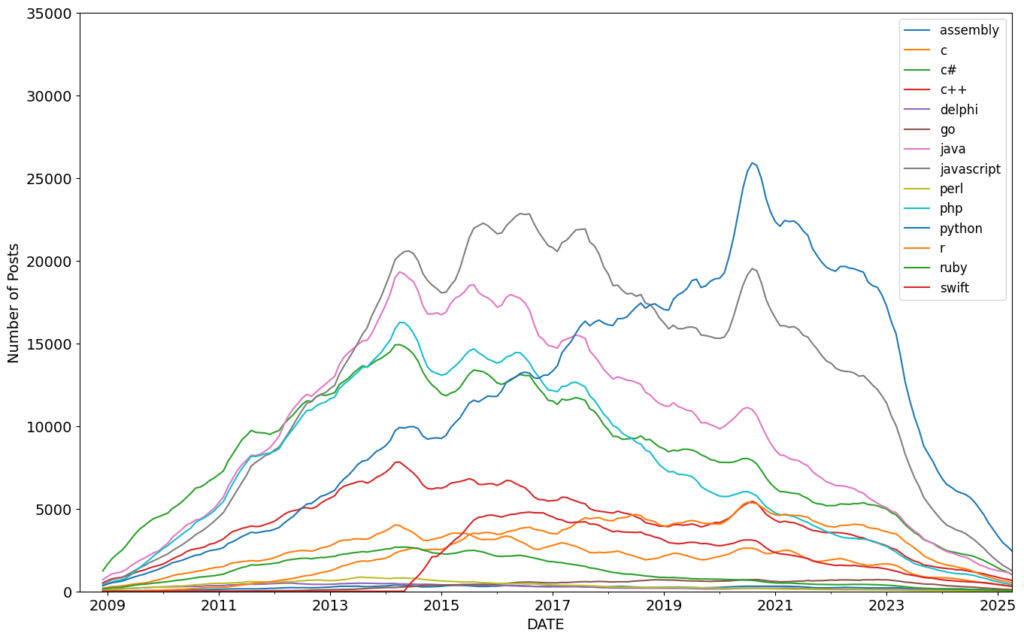
One answer: require agents to make small payments in exchange for up-to-date information. This is already technically possible with Bitcoin, and the tooling is maturing fast.
L402 LangChain BTC Alby Agent ToolsProject Examples: Paid API access for agents, agent-to-agent payments, per-query data monetisation, autonomous agent wallets
Block 2: Bitcoin as financial infrastructure
Financial infrastructure you can actually deploy.
This bucket is for builders who want to go beyond accepting payments and into building financial primitives themselves.
Bitcoin banking and financial services
Bitcoin-powered financial products have a long track record of success. Lending platforms, currency exchanges, and banking interfaces have all found viable markets, and the infrastructure powering them gets more capable every year.
Tools: Bitcoin Core, LND, Core Lightning, Eclair, Voltage, Amboss
Bitcoin Core LND Core Lightning Eclair Voltage AmbossExamples: Bitcoin-backed lending, decentralized exchange platforms, business banking interfaces, treasury management tools, Lightning routing nodes
Custom Bitcoin wallets
Wallets are easy to overlook as a project type because they seem obvious. In reality, the wallet category is one of the most active areas of Bitcoin development — new wallet types, improved UX, and embedded in-app wallets are all live opportunities.
With Taproot Assets now bringing stablecoin support to Bitcoin, the wallet category is likely to expand further in coming years.
Tools: Bitcoin Dev Kit (BDK), Lightning Dev Kit (LDK), Taproot Assets, Breez SDK, LNBits
BDK LDK Taproot Assets Breez SDKExamples: Self-custodial mobile wallets, in-app embedded wallets, stablecoin wallets on Bitcoin, multi-sig custody tools
Block 3: Bitcoin as open coordination and data layer
Open coordination and ownership without a platform.
This bucket is less about moving money and more about what becomes possible when identity and data are decentralized.
Decentralized identity applications
Nostr is one of the most popular protocols for building Bitcoin-native applications today. Its first use case was a decentralized alternative to Twitter, but at its core it is a simple, developer-friendly protocol for any application that needs censorship-resistant identity and communication.
Tools: Nostr protocol, NOSTR Wallet Connect
Examples: Decentralized social apps, creator monetization platforms, censorship-resistant publishing, self-sovereign login systems
NOSTR NWC FROSTR ION BITCHATBitcoin DeFi and Scaling Solutions
Many projects are looking Bitcoin as a store of value or payment rail. A new generation of scaling protocols and smart contract frameworks is turning it into a programmable financial infrastructure, without changing its base layer. This is one of the most technically ambitious areas of Bitcoin development today, and for the right project, one of the most interesting to build on.
Three protocols worth knowing:
BitVM enables Turing-complete smart contracts on Bitcoin without requiring changes to the network’s consensus rules. Rather than executing computations on Bitcoin, the Bitcoin Network is used to verify computations, similarly to optimistic rollups. This opens the door to trust-minimized bridges, rollups, and Bitcoin-native DeFi applications including lending, decentralized exchanges, and derivatives.
Botanix Spiderchain is a decentralized, EVM-equivalent Bitcoin scaling protocol that launched mainnet in 2025. The idea is to use the massive existing financial infrastructure tooling available for EVM and use it to build a defi system denominated natively in Bitcoin.
Ark / Arkade launched to public beta in late 2025 as a scaling layer and for programmable finance. Ark can be implemented on Bitcoin without requiring consensus changes, and uses shared UTXOs and virtual transaction outputs to enable off-chain execution while maintaining unilateral exit paths back to Bitcoin.
BitVM Ark Labs (Ark Defi) Second (Ark Scaling) Botanix SpiderChainExamples: Bitcoin-native lending protocols, trust-minimized BTC bridges, decentralized exchanges, programmable stablecoin infrastructure
The opportunity
Bitcoin’s developer tooling has never been more capable, and the market for Bitcoin-native products has never been larger. Whether the goal is to reduce friction in cross-border payments, build a new kind of financial product, or experiment with decentralized coordination – the infrastructure is there.
The projects that succeed are not necessarily the ones built by protocol experts. They are the ones built by people who understand a real business problem and are willing to experiment until they find the right fit.
Did this spark an idea?
Velas Commerce specializes in turning Bitcoin ideas into real-world platforms. If you are exploring a project in any of these categories, from a quick prototype to a full production build; we are here to help.
Get in touch: engineering@velascommerce.com