

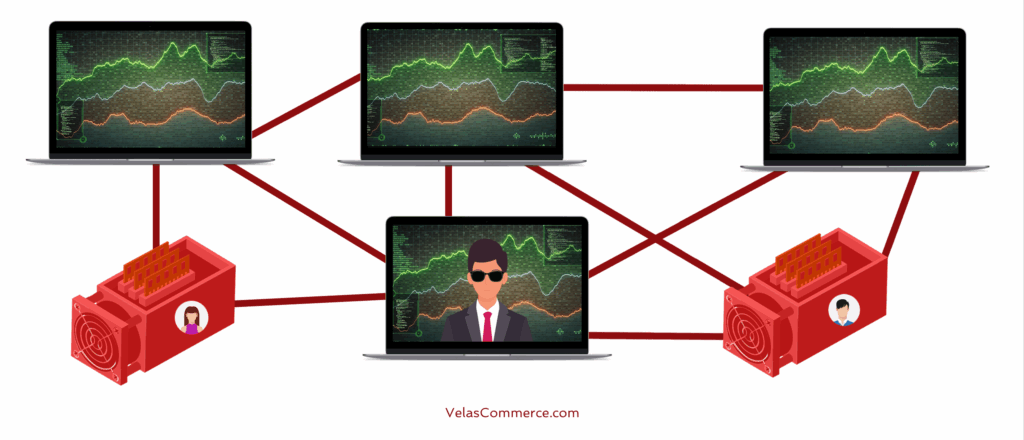
The Bitcoin Network is made up of a huge array of actors: users with wallets, miners, mining pools, community influencers, businesses, and noderunners. Each plays their own part in achieving the consensus required to make the Network function through a completely voluntary protocol.
Recently we’ve been thinking a lot about Bitcoin noderunners, inspired both by a Bitcoin Magazine article that argues only Bitcoin nodes directly tied to economic activity matter and the ongoing debate over Op Return and spam controls in Bitcoin. The Bitcoin Magazine article makes some valid points, but it dismisses a critical part of the Bitcoin Network when it says that only “economic nodes” matter.
I.e. if your node is not connected to a business processing a large amount of bitcoin transactions or connected to a miner, also known as an economic node, it isn’t a useful part of the Bitcoin Network.
This argument gets a few aspects right, but it overlooks something essential. So today, let’s push back. The ongoing debate over appropriate levels of spam control versus censorship resistance in Bitcoin node implementations serve as further evidence that a vibrant community of noderunners are indeed an important part of the Bitcoin Network.
The purpose of this research is not to weigh in on Op Return, but rather to deliver a simpler message.
All nodes and noderunners matter. Here’s why.

What is an Independent Node?
The network of Bitcoin nodes isn’t just made up of economic nodes, in fact there is a large number of independent nodes: fully-validating Bitcoin nodes run by an individual, enthusiast, small project or group that is not directly involved in mining or processing economic transactions.
Independent nodes are different from the light clients used in most Bitcoin wallets. They are different from Sybil nodes, which are essentially a dummy node spun up to attack the Network. And independent nodes are not necessarily economic or mining nodes, in that they aren’t always connected to their own source of Bitcoin transactions.
But these independent nodes do play an important part in the Network. Independent doesn’t mean irrelevant, it means sovereign.
To get further in, let’s look at how consensus works in Bitcoin.
How Bitcoin Consensus Really Works
Bitcoin’s consensus mechanism – defining the rules all participants in the Network must follow – is pretty complicated stuff. Bitcoin consensus is a technical matter, but there are lots of factors that impact when and how those technical changes are made, enacted, and enforced. Community consensus is crucial to enacting technical consensus. A wide variety of communities matter here including Bitcoin community members, businesses and developers.
Lucky for us there has been a lot of excellent research into the subject. I’ll quote from this BCAP research paper for a great definition:
“Bitcoin consensus refers to the set of rules that define the validity of transactions and blocks. These rules are encoded in software run by and enforced by the network’s nodes, ensuring that all participants agree on the blockchain’s transaction history.“
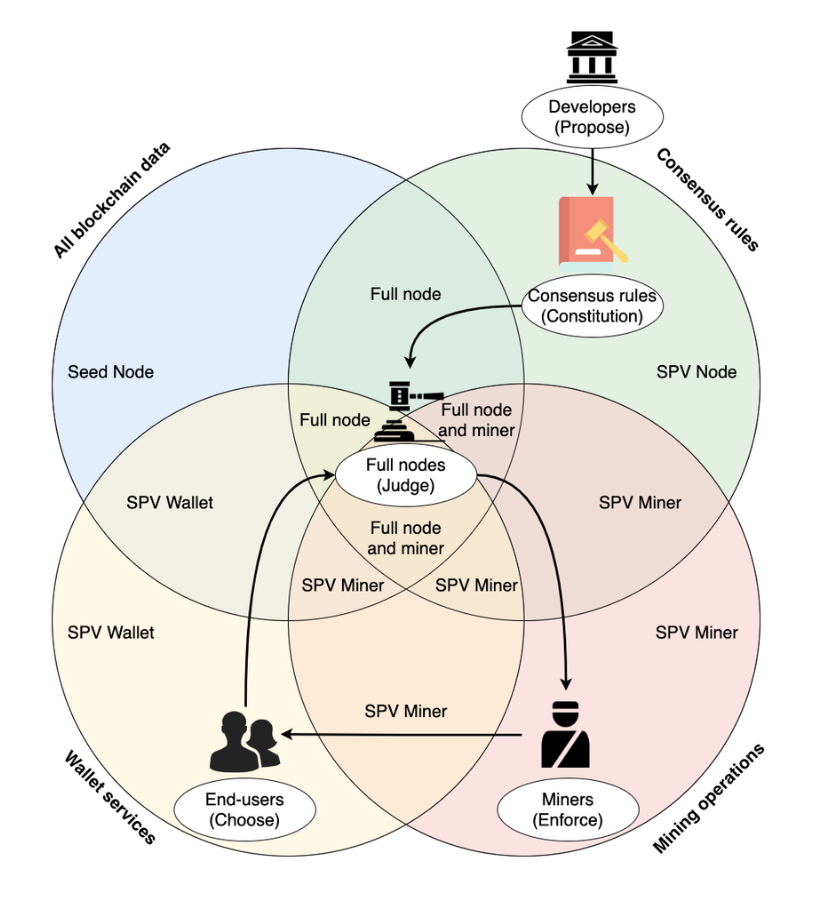
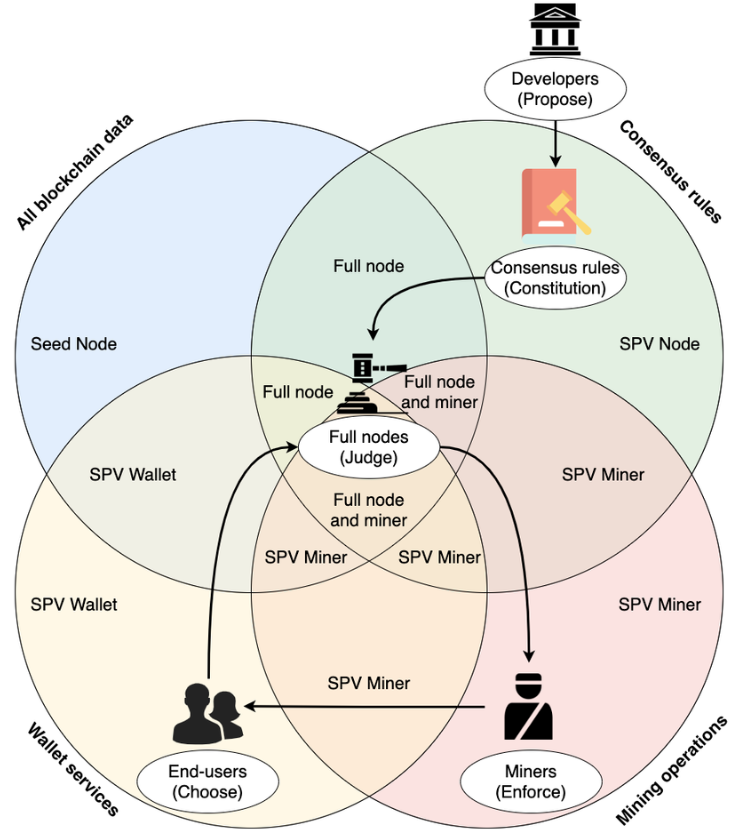
See how nodes form a central part of the definition here? Consensus emerges from many overlapping forms of influence, not just hash rate or capital.
To put a picture to this idea, check out this diagram from “An Empirical Study on Governance in Bitcoin’s Consensus Evolution”
History Is On Our Side: Bitcoin Independence Day
This central location of full Bitcoin nodes in this diagram isn’t just an artistic flair and it’s not just theory. Noderunners are actually central to the consensus mechanism of the Bitcoin Network. The power of noderunners in the Bitcoin Network has actually been demonstrated in practice during the Blocksize Wars.
The idea behind economic nodes is that in the event of a chain split, the side with the most economic activity will “win” in the end. And certainly economic activity is an important factor, but it’s not the only one that matters. During the Blocksize Wars a decent percentage of the nodes on the Bitcoin network activated what was known as a User Activated Soft Fork, or UASF. Nodes that were running the UASF version of Bitcoin were essentially threatening to cause a fork in the network if the SegWit upgrade was not activated. And it worked.
Also during this period, this community led uprising of independent noderunners successfully prevented a Bitcoin block size increase that was championed by miners and large exchanges. In fact, this “New York Agreement” between miners and large exchanges – major economic nodes – could be viewed as a cartel attempting to exert influence on the consensus rules of the Bitcoin Network.
But the miners and exchanges backed down because independent noderunners refused to move.
The New York agreement was fought tooth and nail by independent noderunners. And their efforts succeeded! This achievement is marked by “Bitcoin Independence Day”, and is now a part of the Bitcoin calendar, like “Bitcoin Pizza Day”. Check out this great article to learn more about Bitcoin Independence Day, and on August 1st let’s all celebrate the power of the independent noderunners and decentralized consensus!
Protecting Bitcoin From Sybil Attacks
Another argument can be made that independent nodes do not protect the Network from Sybil attacks as effectively as an economic node. Let’s get into that.
A Sybil attack targets peer-to-peer networks where the attacker spins up an overwhelming number of nodes in the network to attempt a change by force.
For example, say we spin up 80,000 Bitcoin nodes, vastly outnumbering the honest nodes on the network. These “sybil” nodes start relaying and validating some change to the consensus rules that benefits us alone.
Imagine 80,000 nodes out of nowhere suddenly validating OP_CTV transactions (a proposed but not yet implemented Bitcoin opcode) because our business relies on OP_CTV to function.
In this scenario, we try to force the Bitcoin Network to play by our new rules.
What happens?
These transactions don’t have a shot at entering valid blocks unless someone pays for the cost of mining them! And the cost of mining is one of the pillars of security of the Bitcoin Network.
Here noderunners help form part of the overall immune system of the Network to these types of attacks, rejecting invalid transactions before they even have a chance to reach the miners.

Leveling Up
All this is not to say that a noderunner can’t level up. As demonstrated in the Sybil attack example, Bitcoin miners play a critical role in the Network. Adding a Bitaxe to a full Bitcoin node essentially levels it up!
And the same goes for running an economic node – connecting it to your wallet, your Lightning node, or connecting a node to your business. They are all inarguably ways to increase the weight of a Bitcoin node’s “vote” on the rules of the Network.
It’s just that being an economic node is not the only thing that matters.

Forward, Noderunners
Keeping that Bitcoin Node running is a critical part of securing the Bitcoin Network. If you care about Bitcoin, have the budget, the curiosity and the technical capacity – run a node!
Check out these products and services to get started!
- LunaNode: https://www.lunanode.com/guides/btcpay
- BTCPayServer: https://btcpayserver.org/
- Voltage: https://www.voltage.cloud/lightning-nodes
- Blockstream Greelight: https://blockstream.com/lightning/greenlight/
- MyNode: https://mynodebtc.com/
- Umbrel: https://umbrel.com/
- Start9: https://start9.com/
Once your node is running and you want to level up, connect it to your Bitcoin wallet, a Bitaxe miner, a Lightning Node or to your business!
Noderunners promote the success of a voluntary, decentralized economic system that is changing the world.
Noderunners Matter.
References
- https://cointelegraph.com/news/satoshi-comments-on-arbitrary-data-shows-how-old-the-op-return-debate-is
- https://bitcoinmagazine.com/technical/economic-bitcoin-nodes-why-you-need-to-use-your-node-for-it-to-matter
- https://github.com/bitcoin-cap/bcap
- https://dl.acm.org/doi/10.1145/3699600
- https://bitbo.io/calendar/bitcoin-independence-day/
- https://www.geeksforgeeks.org/ethical-hacking/sybil-attack